Case Study
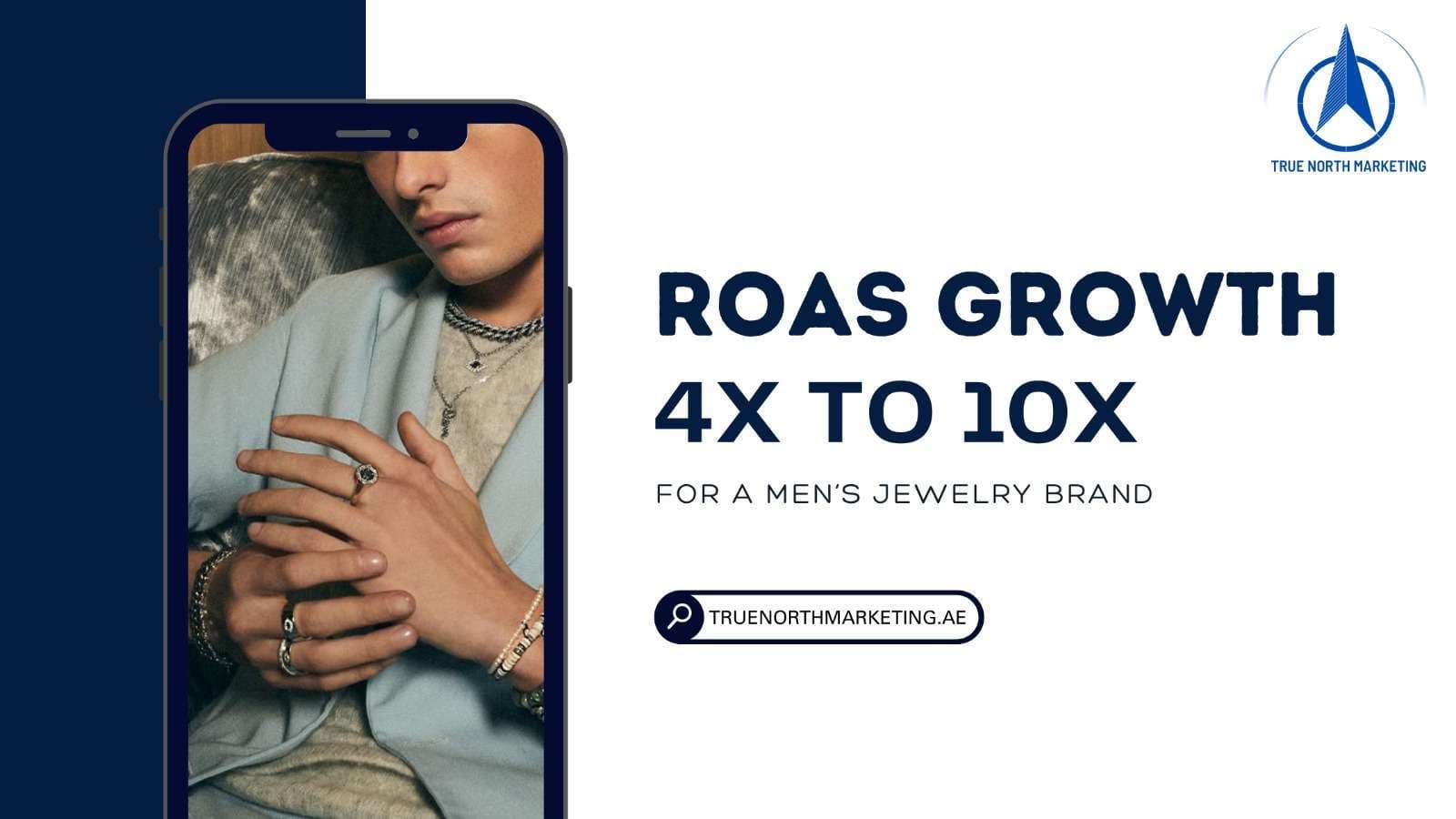
How We Took a Men's Jewelry Brand from 4X to 10X ROAS in Just 3 Months
Discover how True North Marketing combined AI and performance marketing to transform a men's jewelry brand's ROAS from 4X to 10X in just three months.
By Thavi Achharya · January 25, 2024 · 5 min read
const{Fragment:e,jsx:n,jsxs:i}=arguments[0];function _createMdxContent(a){const t={a:"a",blockquote:"blockquote",h2:"h2",h3:"h3",li:"li",p:"p",table:"table",tbody:"tbody",td:"td",th:"th",thead:"thead",tr:"tr",ul:"ul",...a.components},{AuthorNote:r,Callout:o,Checklist:s,CopySummaryBox:c,FAQAccordion:d,SourceList:l}=t;return r||_missingMdxReference("AuthorNote",!0),o||_missingMdxReference("Callout",!0),s||_missingMdxReference("Checklist",!0),c||_missingMdxReference("CopySummaryBox",!0),d||_missingMdxReference("FAQAccordion",!0),l||_missingMdxReference("SourceList",!0),i(e,{children:[n(t.p,{children:"This article is for direct-to-consumer jewelry and accessories brands in the GCC where average order value, trust, and creative detail matter as much as prospecting efficiency."}),"\n",n(t.p,{children:"In this engagement, account ROAS moved from roughly 4X toward about 10X over three months. The work centered on allocation and creative testing discipline, then scaling only after conversion quality stabilized. Jewelry behaves differently than softlines: consideration cycles are longer, creative must communicate material truth, and demand spikes around gifts and occasions."}),"\n",n(c,{summary:"Men’s jewelry ecommerce: ~4X to ~10X platform ROAS in 90 days by reallocating to margin-positive SKUs, testing creative by intent (gifting vs self-purchase), and scaling only where return and fulfillment could absorb volume. AI accelerated variants; humans owned claims and brand fit. Outcomes are context-specific—not a guarantee for every catalog.",label:"Copy summary"}),"\n",n(o,{type:"info",children:n(t.p,{children:"ROAS and timelines describe this client’s context (category, margin, creative\nassets, and tracking setup). They are not a promise for every account."})}),"\n",n(s,{title:"Key takeaways",items:["SKU-level economics beat blended account averages when you move budget.","Separate intents: self-purchase, gifting, and occasion windows need different hooks and landing parity.","Creative fatigue shows faster on visually repetitive precious-metal and stone shots—refresh on a schedule, not when performance has already collapsed.","Track payback and margin, not ROAS alone."]}),"\n",n(r,{name:"Thavi Achharya",role:"CEO, True North Marketing",children:n(t.p,{children:"This engagement combined structured creative testing, AI-assisted insights,\nand tighter audience and budget allocation. The case study focuses on how we\nmoved levers—not on a formula that copies to every catalog."})}),"\n",n(t.p,{children:"When this men’s jewelry brand first came to us, they were doing well, but not at the level the business needed. They had a solid product, a credible site, and about 4X return on ad spend—acceptable in isolation, but not enough to fund the growth they wanted."}),"\n",i(t.blockquote,{children:["\n",n(t.p,{children:"We were doing fine, but we knew we could do better. We just didn't know how much better. — Client CMO"}),"\n"]}),"\n",n(t.h2,{children:"The challenge: stuck at 4X ROAS"}),"\n",n(t.p,{children:"The account showed a familiar pattern:"}),"\n",i(t.ul,{children:["\n",n(t.li,{children:"ROAS had plateaued near 4X despite ongoing optimization."}),"\n",n(t.li,{children:"Spend was spread in ways that did not match SKU-level contribution."}),"\n",n(t.li,{children:"Targeting leaned broad; high-intent and high-value segments were underdeveloped."}),"\n",n(t.li,{children:"Creative had begun to fatigue—similar angles and metals repeated too long."}),"\n"]}),"\n",n(t.h2,{children:"Why jewelry is not fashion"}),"\n",i(t.table,{children:[n(t.thead,{children:i(t.tr,{children:[n(t.th,{children:"Factor"}),n(t.th,{children:"Fashion (apparel)"}),n(t.th,{children:"Jewelry / accessories"})]})}),i(t.tbody,{children:[i(t.tr,{children:[n(t.td,{children:"Consideration"}),n(t.td,{children:"Often trend- and fit-driven"}),n(t.td,{children:"Trust, authenticity, and detail"})]}),i(t.tr,{children:[n(t.td,{children:"AOV strategy"}),n(t.td,{children:"Bundles, multi-SKU carts"}),n(t.td,{children:"Gifting, engraving, premium packaging"})]}),i(t.tr,{children:[n(t.td,{children:"Creative risk"}),n(t.td,{children:"Lifestyle and UGC scale more easily"}),n(t.td,{children:"Macro detail, reflection, and careful claims"})]}),i(t.tr,{children:[n(t.td,{children:"Seasonality"}),n(t.td,{children:"Collections and drops"}),n(t.td,{children:"Occasions, holidays, cultural calendars"})]})]})]}),"\n",i(t.p,{children:[n(t.a,{href:"https://www.thinkwithgoogle.com/",children:"Google’s retail and shopping research"})," consistently shows that high-consideration categories need creative and landing experiences that reduce doubt before scale—jewelry sits firmly in that bucket."]}),"\n",n(t.h2,{children:"Execution plan"}),"\n",n(t.h3,{children:"Phase 1: Data and allocation reset (weeks 1–2)"}),"\n",n(t.p,{children:"We audited SKU-level performance, creative fatigue, and budget concentration. The consistent finding: margin-positive SKUs were under-funded relative to downstream value, and several creative batches had outlived their useful performance window."}),"\n",n(t.h3,{children:"Phase 2: Creative and offer iteration (weeks 3–6)"}),"\n",n(t.p,{children:"We increased variant testing across hooks—gifting, self-purchase, materials, and occasion windows—and tightened landing parity with product detail pages. AI-assisted drafting accelerated variants; humans approved claims, policy, and brand fit, which matters acutely in jewelry."}),"\n",n(t.p,{children:"We do not publish tactic-level lift tables here; those figures are not comparable across accounts without full margin and audience disclosure."}),"\n",n(t.h3,{children:"Phase 3: Audience and scaling discipline (weeks 7–10)"}),"\n",i(t.ul,{children:["\n",n(t.li,{children:"Refined lookalike and intent stacks after clean conversion events were reliable."}),"\n",n(t.li,{children:"Paused clusters that produced clicks without purchases once statistical confidence allowed."}),"\n",n(t.li,{children:"Scaled only where return and fulfillment could absorb additional volume."}),"\n"]}),"\n",n(t.h3,{children:"Phase 4: Automation within guardrails (weeks 11–12)"}),"\n",n(t.p,{children:"Automation helped with budget shifts inside defined rules, creative rotation, and reporting. We avoided blind automation on claims, pricing, and customer-facing messaging without review."}),"\n",n(t.h2,{children:"Results"}),"\n",i(t.ul,{children:["\n",n(t.li,{children:"ROAS (reported in ad platforms): from roughly 4X toward about 10X over the program window, reviewed weekly with exclusions and return data."}),"\n",n(t.li,{children:"Efficiency: customer acquisition cost and conversion efficiency improved materially; we do not publish precise secondary percentages as universal benchmarks."}),"\n"]}),"\n",n(t.h2,{children:"Why this worked beyond “using AI”"}),"\n",n(t.p,{children:"AI was an accelerator, not the strategy. The driver was operational discipline: clear hypotheses by funnel stage, aggressive creative iteration with fast pruning, audience refinement from conversion-quality feedback, and controlled scaling only after consistent weekly signal."}),"\n",n(s,{title:"Replication checklist",items:["Audit SKU-level performance before increasing spend.","Build separate hooks for gifting, self-purchase, and occasion intent.","Use dynamic retargeting with product-level relevance and frequency caps.","Track payback and margin, not blended ROAS alone."]}),"\n",n(t.h2,{children:"Next step"}),"\n",i(t.p,{children:[n(t.a,{href:"/en/contact",children:"Contact True North"})," for a scoped review—bring catalog, margin bands, and current creative batches. Related reading: ",n(t.a,{href:"/en/blog/fashion-brand-15x-roas-case-study",children:"fashion case study"}),", ",n(t.a,{href:"/en/blog/personalization-performance-marketing",children:"personalization"}),", and ",n(t.a,{href:"/en/marketing",children:"performance marketing"}),"."]}),"\n",n(t.h3,{children:"Recommended internal reading"}),"\n",i(t.ul,{children:["\n",n(t.li,{children:n(t.a,{href:"/en/blog/fashion-brand-15x-roas-case-study",children:"Fashion Brand Case Study: 15X ROAS"})}),"\n",n(t.li,{children:n(t.a,{href:"/en/blog/personalization-performance-marketing",children:"Personalization in Performance Marketing"})}),"\n",n(t.li,{children:n(t.a,{href:"/en/blog/how-to-spend-1000-on-ads",children:"How to Spend $1,000 on Ads"})}),"\n"]}),"\n",n(d,{title:"FAQ: Jewelry ecommerce ROAS growth",items:[{question:"Can a jewelry brand jump from 4X to 10X ROAS quickly?",answer:"It is possible in some situations, but not guaranteed. The probability improves when product economics, landing experience, and campaign structure are already solid before scaling."},{question:"What is the most common reason jewelry ad accounts plateau?",answer:"Creative fatigue and undifferentiated targeting are common causes. Many accounts repeat the same visual language and audience assumptions long after performance signals have shifted."},{question:"What should brands monitor besides ROAS?",answer:"Monitor CAC trend, repeat purchase rate, payback period, and contribution margin by campaign. ROAS alone can hide quality and profitability issues."}]}),"\n",n(l,{title:"External sources",items:[{label:"Google: Retail and shopping behavior insights",href:"https://www.thinkwithgoogle.com/"},{label:"Meta Business: Dynamic ads guidance",href:"https://www.facebook.com/business/help/642911355777551"},{label:"Shopify: Ecommerce conversion optimization",href:"https://www.shopify.com/blog/conversion-rate-optimization"}]})]})}return{default:function(e={}){const{wrapper:i}=e.components||{};return i?n(i,{...e,children:n(_createMdxContent,{...e})}):_createMdxContent(e)}};function _missingMdxReference(e,n){throw new Error("Expected "+(n?"component":"object")+" `"+e+"` to be defined: you likely forgot to import, pass, or provide it.")}