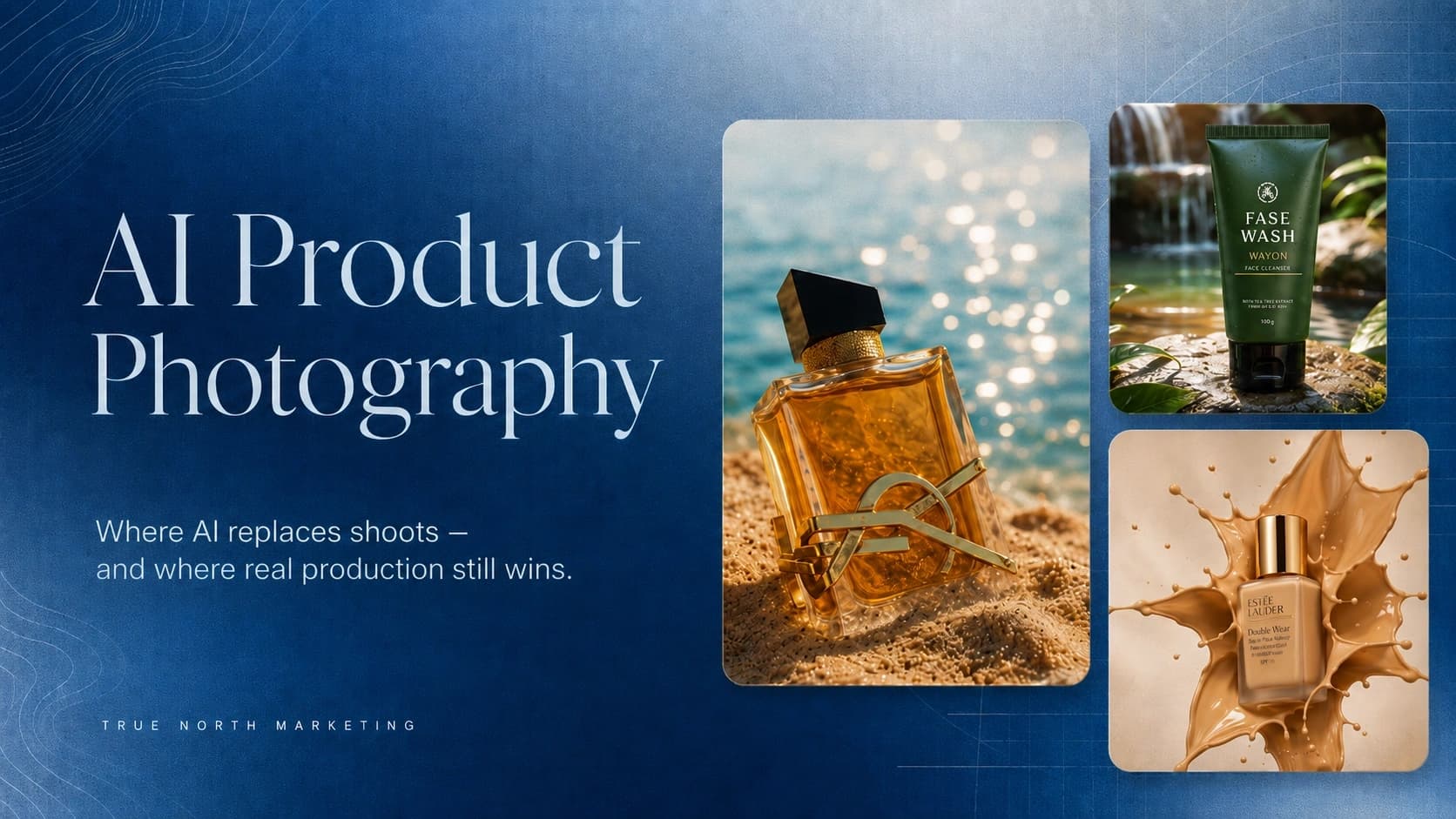
This is for ecommerce and growth leads in the UAE and GCC who ship a high volume of product visuals across ads, marketplaces, and product pages, and who need one clear rule for when AI-assisted production is the right call versus when a studio or on-location shoot is still mandatory. Here is how we draw that line.
Generation is no longer the bottleneck in AI product photography. Approval is. A team can now make more variants than it can responsibly inspect, so the useful question is not how many images a model can produce. It is which images are allowed to represent the product.
We run this as an AI-first production studio, not a prompt window. The stack is in-house and deliberate: Midjourney, Flux, Ideogram, and Higgsfield across the generation tools, structured JSON prompting to keep the scene, lighting, and product attributes consistent instead of random, and Adobe Photoshop for retouching and compositing. We work across the popular tools deliberately, choosing the one that fits the shot, not the one that is trending. AI is one stage in that pipeline, sitting between approved source material and human quality control.

That is how our studio uses AI: as a controlled production layer around an approved brand system. The useful output is not a pile of pretty files. It is a batch of assets with a source reference, channel purpose, QA decision, and performance ID, so the team moves faster without losing product truth.
What does "AI product photography" mean in practice?
In production, "AI product photography" is a repeatable pipeline rather than one prompt.
Control comes from direction, not from luck
The difference between a lucky render and a usable one is control. We do not type a sentence and hope. We feed the model tight reference inputs, the real packshot, the brand palette, the exact bottle, and use structured JSON prompting to lock the scene, the lighting, the camera, and the product attributes, so a set of variants stays consistent instead of drifting. Then we finish in Adobe Photoshop, to correct color to the brand, clean edges, and composite the real label back where generation cannot be trusted with text.
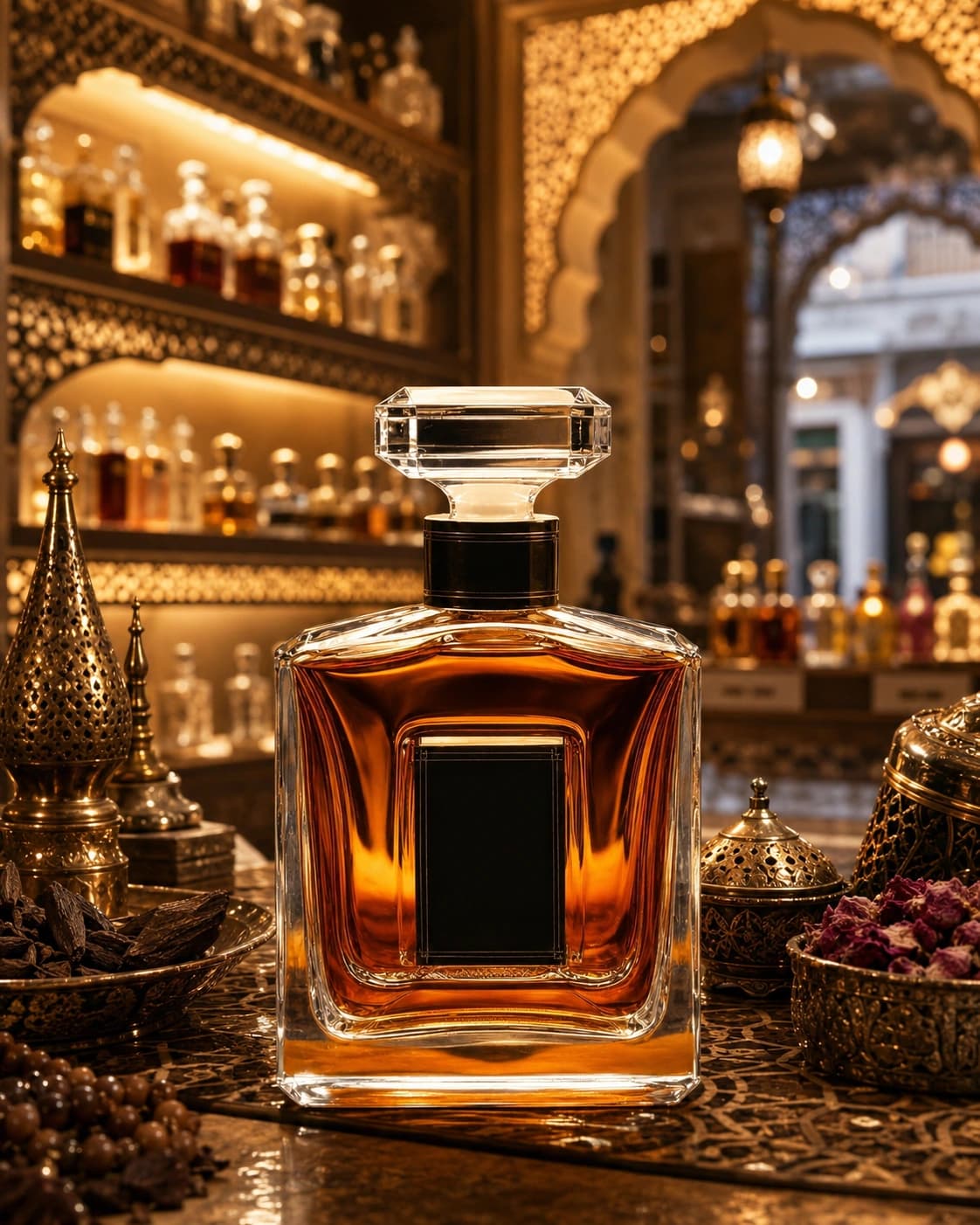
This is what a product world looks like when it is directed, not just prompted: a fragrance staged in a GCC-luxury set, with the palette, the mood, and the composition under our control. For premium and regional launches, this is usually the right layer. Generation explores the concept fast; structured prompting and Adobe finishing lock the hero once the concept is approved.
How do AI avatars fit into spokesperson content?
The studio also produces AI avatars and UGC-style presenters, built with tools like HeyGen, Synthesia, and Hedra and finished under a human edit. For founders who cannot film weekly, or brands that need a consistent spokesperson across dozens of localized cuts, an avatar keeps the face and the message stable while the volume scales. The full use cases, from real estate to clinics, are covered in our AI video, avatars, and UGC guide.

The same discipline applies here as everywhere else. The avatar is a production tool, not a licence to skip judgment. Likeness usage, claims, and script all pass review before anything is treated as campaign-ready.
Short-form video uses the same discipline
AI-assisted motion, built with Runway, Higgsfield, Kling, Veo, and Sora, is useful for format multiplication: nine-by-sixteen hooks, product spins, feature callouts, when the storyboards and brand guardrails are fixed. It is not a substitute for a flagship hero film when the brand depends on a single prestige asset.

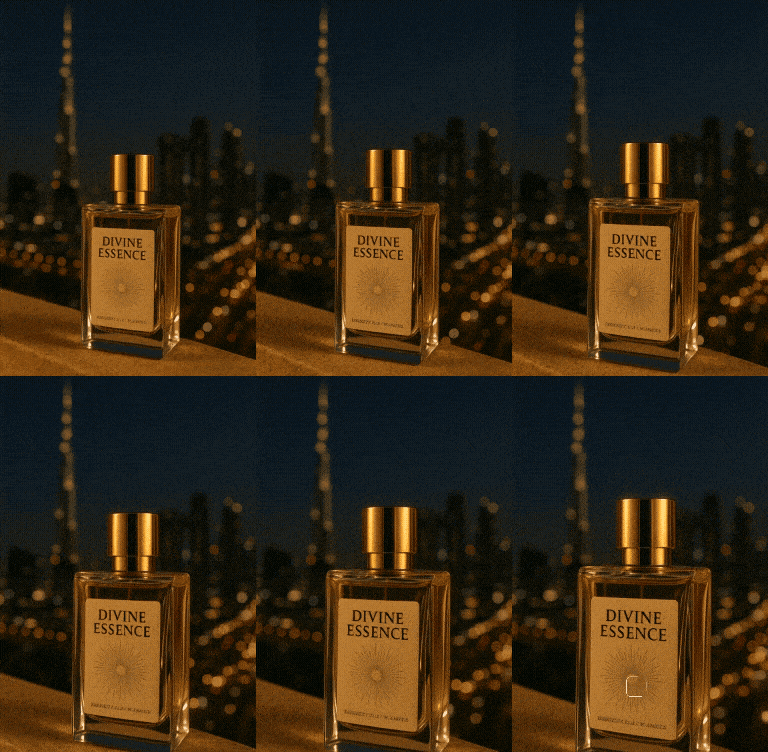
The goal is not an "AI look." It is commercial creative that clears QA and moves the metrics you already report to finance.
AI-first or a real shoot: how do we decide?
The honest answer is rarely all-or-nothing, and we make the call before production starts, not after money is spent. We weigh product accuracy, regulated claims, realism required, budget, timeline, and how the asset will be used. Product truth and brand-anchor status push toward a real shoot or a real reference. Variant volume, surreal scenes, and speed favour generation and Adobe compositing.
Where does AI fail, and where should you not force it?
These are predictable failure modes, so we use them as review prompts before an asset is approved.
- On-pack label text: generators still render logos and copy as garbled characters, which is an instant reject for any real listing.
- Luxury and perception-led categories: when the product is partly story and rarity, a generic glossy render undermines the positioning.
- Highly reflective surfaces: jewelry, chrome, and glass, where small errors read as cheap or fake and drive returns.
- Realism limits: hands, fabric drape, and complex shadows, which reviewers notice before the algorithm does.

Look at the label on that bottle. The lighting, the glass, the set are all convincing, but the text is nonsense. That is the single most common failure in generated product imagery, and it is why label-bearing hero shots get the real label composited back in Adobe, or a real capture, never straight from a generator.
Why must retail and marketplace visuals still tell the truth?
On a marketplace, the visual carries the whole trust burden: spec legibility, real proportions, and a finish that matches what arrives. Here, the packshot stays truthful and AI extends the context, the shelf, the lifestyle scene, the seasonal background, within platform policy.
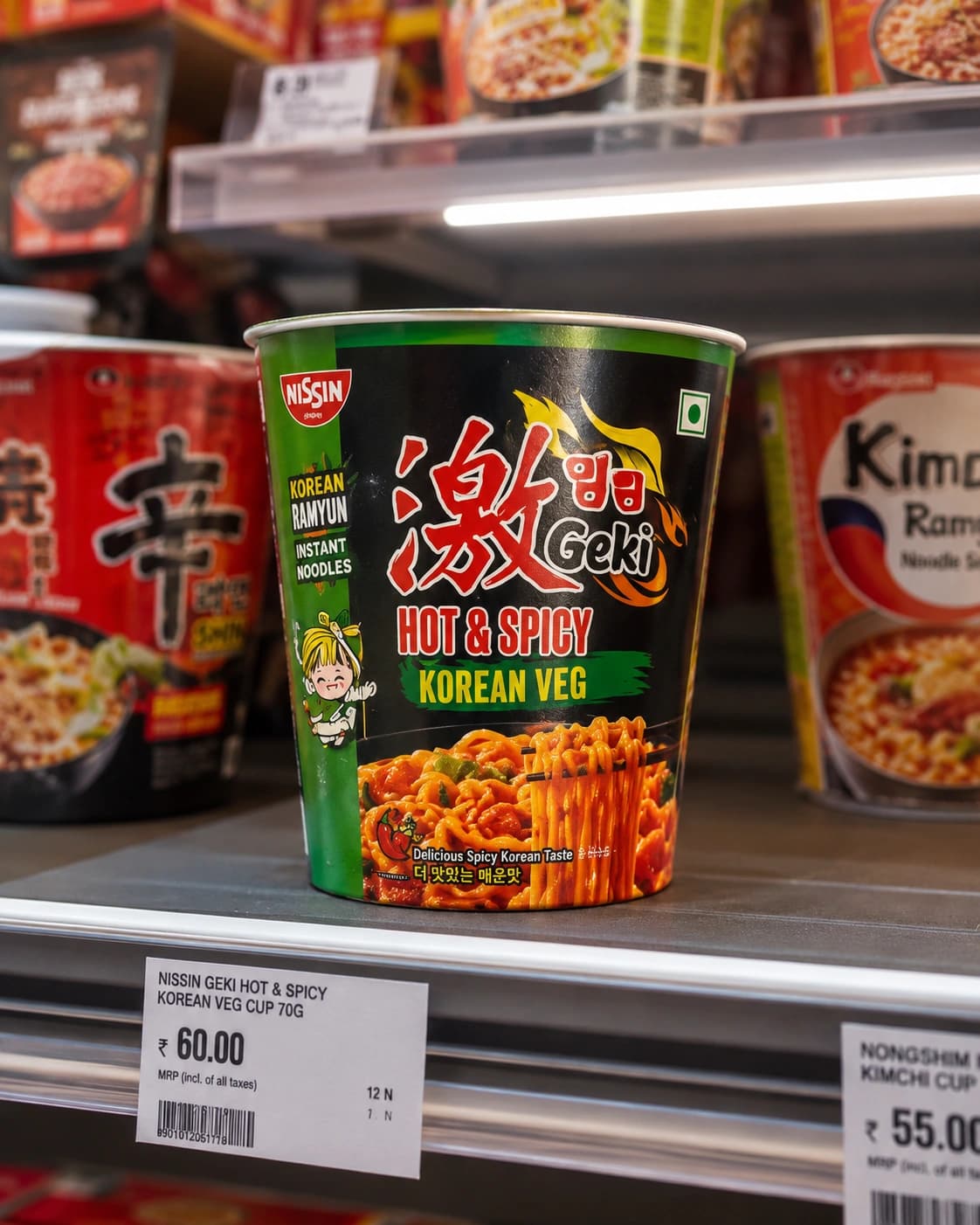
When the branding and the price legibility have to be exact, as in that shelf render, control matters more than speed. That is a case for a controlled capture or the real pack composited in Adobe, with generation reserved for the surrounding scene.
Channel-specific use cases
The right approach changes by where the visual runs. We plan the asset around the job of the placement, not around one master file.
What standards does every deliverable have to clear?
This is the same operating standard we hold across the whole studio, and it is what separates usable output from fast noise.
- Brand first: every asset starts from your brand system, voice, look, and layout rules, so it ships on-brand, not just on time.
- Performance-tied: studio work plugs into the same measurement loop as the campaigns it feeds, so what runs is what converts.
- Production QA: human review on every AI-assisted deliverable for continuity, licensing, brand accuracy, and platform specs.
- Real when needed: AI-first does not mean AI-only. We still shoot real footage when the brief calls for it.
Approval checklist before publication
The approval step is where AI product photography becomes usable rather than just fast.
For premium products, this table is stricter than the generation prompt. The prompt creates options; the checklist decides what is allowed to carry spend.
How do we measure creative, so "good" is not subjective?
We align visuals to the same numbers media and finance already use:
- Paid social: CTR, a thumb-stop proxy where available, and cost per add-to-cart or qualified action.
- Product page: scroll depth, add-to-cart rate, and exit rate on gallery interactions, where implementation allows.
- Blended efficiency: new-customer CAC and payback, not engagement rate in isolation.
This connects our performance marketing and development services with our creative studio: the asset has to satisfy the brand system and remain traceable to a commercial test. The Joey & Pooh case study shows why creative and retention cannot be judged in separate reports.
Founder-checked, and yours to keep
Every frame gets a human edit and grade before it ships, and the deliverables, masters, project files, and usage rights, are handed to you, not locked in a tool nobody else can open. Studio-grade output without studio-sized overhead only works if the quality gate and the ownership are both real.
Where does AI end and the camera still win?
AI extends a strong creative system; it does not set the standard the system is held to. Where the purchase rides on material truth, we keep a verified photograph or a real reference as the anchor and use generation around it. The SHANZAY case study shows the commercial value of faster creative iteration, but it does not prove that generated imagery should replace truthful product photography.
When we scope a brand's visual pipeline, the first question is which shots have to be real, and which can be generated, decided per category and return-risk, not by enthusiasm for the tool. Bring your SKU count, channels, and current return data to our contact form and you get a production plan, not a tool parade.