

Client: GNSeal, a foodservice-equipment brand selling reusable silicone lids for standard GN pans, trading into the UAE and India. Buyer: professional kitchens, restaurant groups and their procurement leads. Engagement: a Shopify storefront build, an AI chat assistant, and a chef-focused article system.
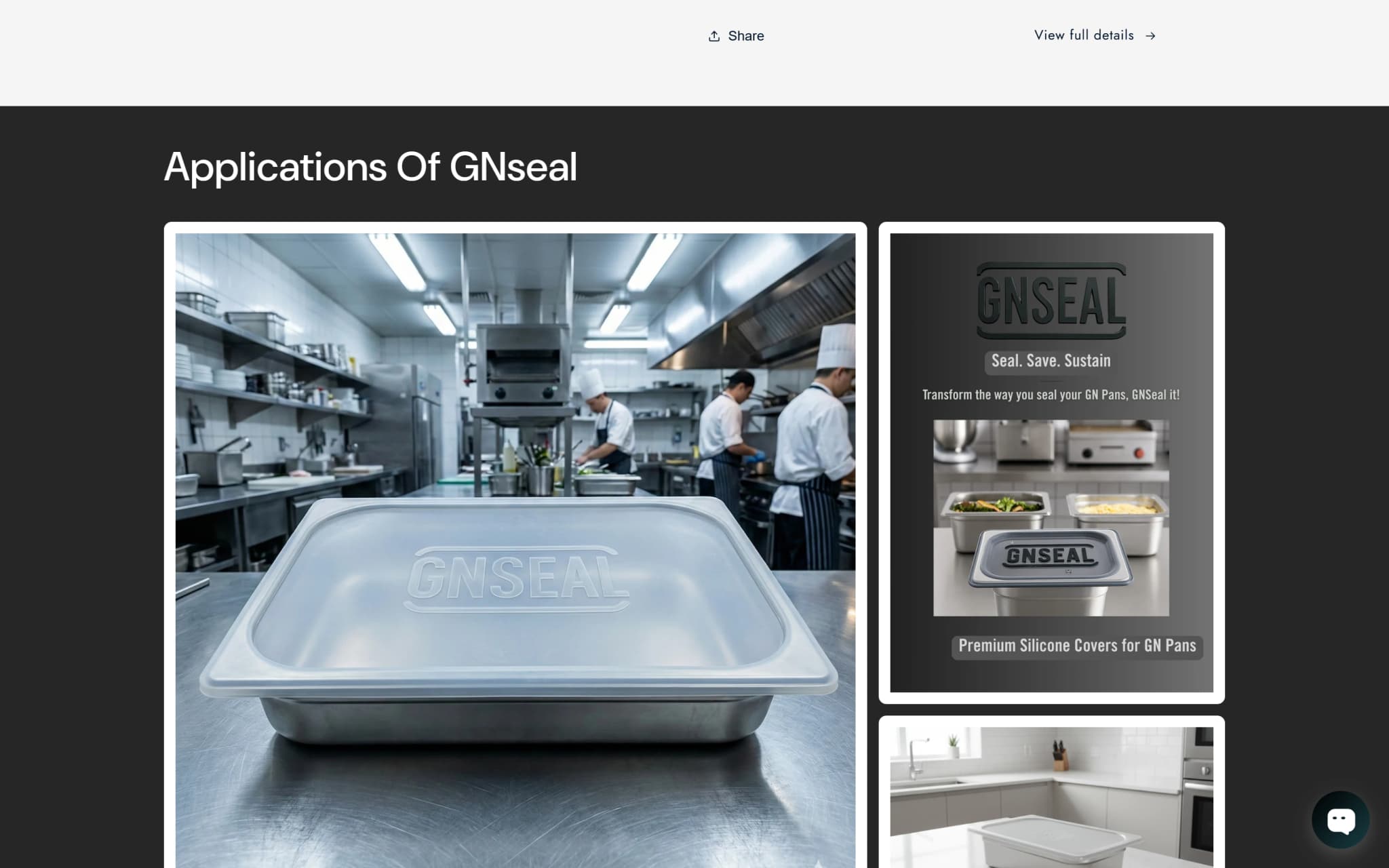
GNSeal replaces cling film in commercial kitchens with reusable silicone lids that fit standard GN pans. That is a simple product with an unglamorous buyer: a chef counting hours, or a procurement lead counting cost per cover. The brief was not a showcase site. It was a store that explains the product quickly, prices it in the right market, and makes the next step obvious, and the client wanted it clean rather than clever.
Measured evidence: On desktop PageSpeed Insights, 22 July 2026, the storefront scores 98 Performance, 100 SEO, 97 Accessibility, 96 Best Practices and 3 of 3 on agentic browsing. A live performance trace measured a 274 ms Largest Contentful Paint, 0.00 Cumulative Layout Shift and a 136 ms time to first byte from the edge.
A storefront built for the people who actually buy
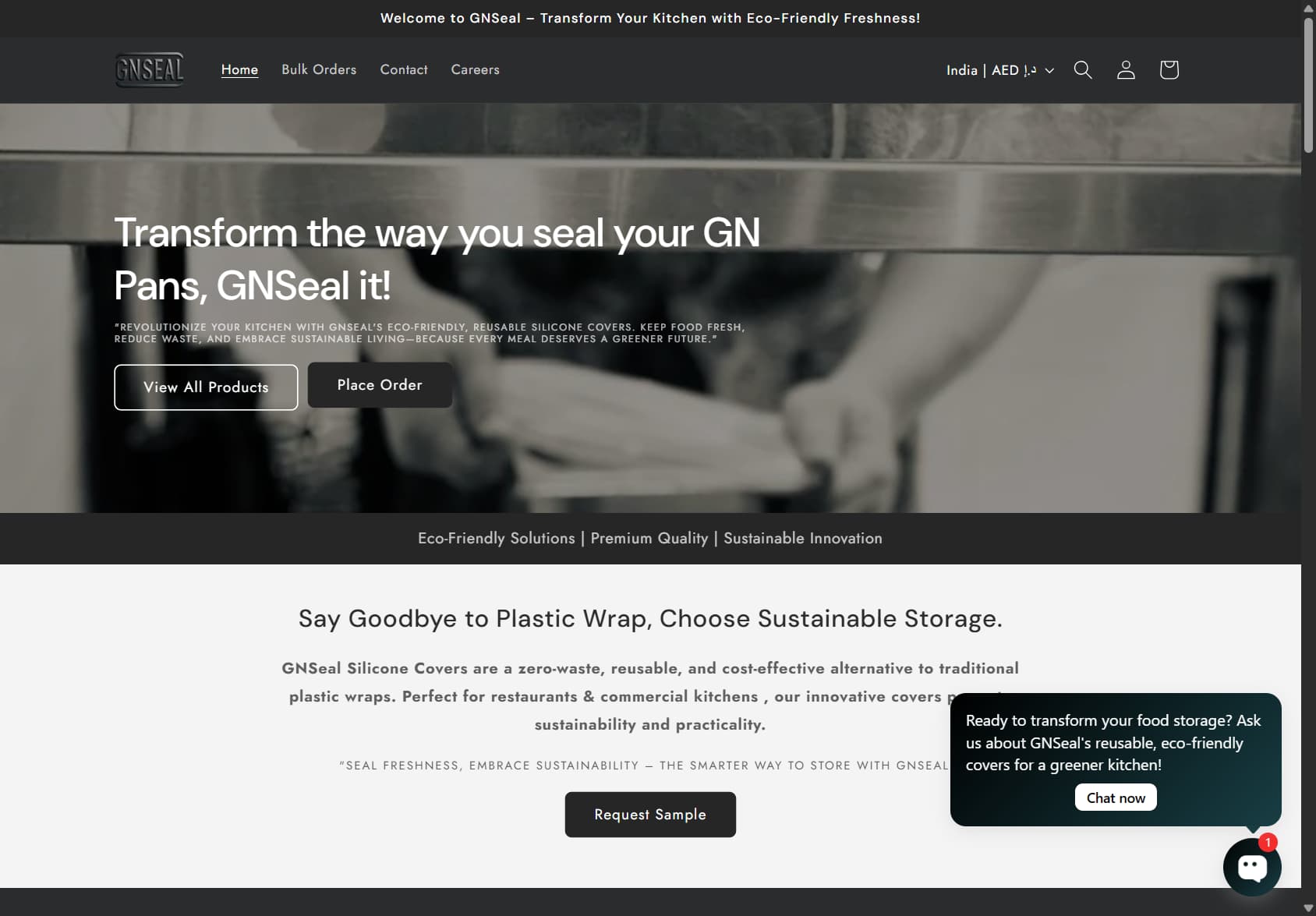
The homepage does one job: land the swap. A single headline puts the product in the reader's own kitchen, a monochrome commercial-kitchen image sets the professional register, and two actions sit directly under it, view the products or place an order. Under that, one line does the commercial work, a zero-waste, reusable, cost-effective alternative to plastic wrap, built for restaurants and commercial kitchens.
Everything else in the navigation is a buying path rather than a brochure page. Bulk orders for volume buyers, a free-sample request for the chef who wants to feel the silicone before committing, an affiliate programme for distributors, and careers for the team. There is no blog-shaped filler in the main navigation and no consumer-store noise. The restraint is the design, and it is what the client asked for.
Because the audience spans two markets, the storefront carries a market and currency switch, and it serves localised content for the region it is browsed from. A chef in Dubai and a distributor in India see prices they can act on rather than a converted guess.
The build
The store runs on Shopify with a Dawn-based theme, served through a Cloudflare edge. That combination is deliberate: Shopify owns payments, tax and checkout compliance so nobody has to hand-roll them, and the theme layer stays light enough to keep the storefront fast.
The performance work shows in the trace. The hero image is preloaded with a responsive source set so the largest element starts downloading immediately, stylesheets are preloaded rather than discovered late, and the Shopify CDN is preconnected before it is needed. The homepage records a 274 ms Largest Contentful Paint and zero layout shift, which is the part shoppers actually feel.
Security is enforced at the edge rather than assumed. The storefront ships a Content-Security-Policy that blocks mixed content, upgrades insecure requests and denies framing outright, alongside HSTS and MIME-sniffing protection. For a store taking commercial orders, that baseline is not optional.
An AI assistant that knows the business
Most storefront chat widgets are a dead end: a form that promises a reply within a working day. GNSeal's is an assistant briefed on the business itself, so it can answer the questions a chef actually asks, what the covers fit, how they behave at temperature, how bulk pricing works, and point the visitor to the right page instead of leaving them to hunt.
It also opens the conversation on context rather than a generic greeting, inviting the visitor to ask about the reusable covers for a greener kitchen. That is a small thing that changes the hit rate: the prompt matches what the page is about, so the visitor knows the assistant is worth asking.
The design rule is the same one we apply to every assistant we ship. It guides and navigates; it does not pretend to be a person, and it does not sit between a serious buyer and a human when the order gets big enough to need one.
Agent-ready commerce
Buyers are not the only visitors any more. AI shopping assistants now read storefronts on a customer's behalf, and most stores are illegible to them.
This one is not. It passes agentic browsing 3 of 3 on a live audit, and it publishes the discovery surfaces an agent looks for: an agent instruction document, a commerce-protocol descriptor, and a machine endpoint for catalogue and cart. The practical effect is that when a buyer asks an assistant to find reusable GN pan lids, GNSeal can be read, understood and acted on rather than skipped.
That result is earned by the same discipline as the SEO score: clean semantic markup, real content in the HTML, and a structure that says plainly what each page is.
That discipline extends to how the store presents itself off-site. Each page carries deliberate SEO metadata and a self-referencing canonical, product and organisation structured data so search engines read the catalogue as entities rather than loose text, and Open Graph and Twitter share cards so a link to GNSeal posts as a proper preview, with the product image, title, and description, instead of a bare URL. For a store that grows by being sent between kitchens and procurement leads, a link that previews correctly is part of the product.
An article system written for chefs
The store carries a proper article system rather than a token blog, and the pieces are written for the buyer's actual arithmetic instead of for search volume. One works through how much a busy restaurant really spends on cling film. One compares GNSeal directly against a box of cling film. One covers efficiency, safety and time saved in the kitchen.
That is the right editorial instinct for B2B. A chef does not need a listicle; they need the cost case, the comparison and the workflow argument, so the article library doubles as sales collateral the team can send into a bulk-order conversation.
What the audit says
Re-audited live on 22 July 2026, desktop PageSpeed Insights returns 98 Performance, 100 SEO, 97 Accessibility, 96 Best Practices and a clean sweep on agentic browsing, with a 274 ms Largest Contentful Paint, zero layout shift and a 136 ms time to first byte.
The lesson is not that Shopify is fast. It is that a focused build stays fast. The store ships two products, five purposeful pages and one assistant, and every one of them exists because a chef or a buyer needed it. Restraint at that level is a senior decision, not a compromise: we cut everything that did not move an order, and near-perfect scores, sub-300 ms loads and full agent-readiness are what is left standing.
What the client reports
The technical scores above are ours, measured live. On the outcome, we will let the client keep it simple.
True North rebuilt our Shopify store the way we wanted it: clean, easy to order from, and simple for our customers to use. We're happy with how the website turned out.
 Sagar KhannaFounder, GNSeal
We publish that as-is rather than dressing it in numbers we did not measure ourselves. The audit scores, load times and agent-readiness above are ours.
Selling into professional buyers and your store is fighting you? See Our Services or Book An Audit.